




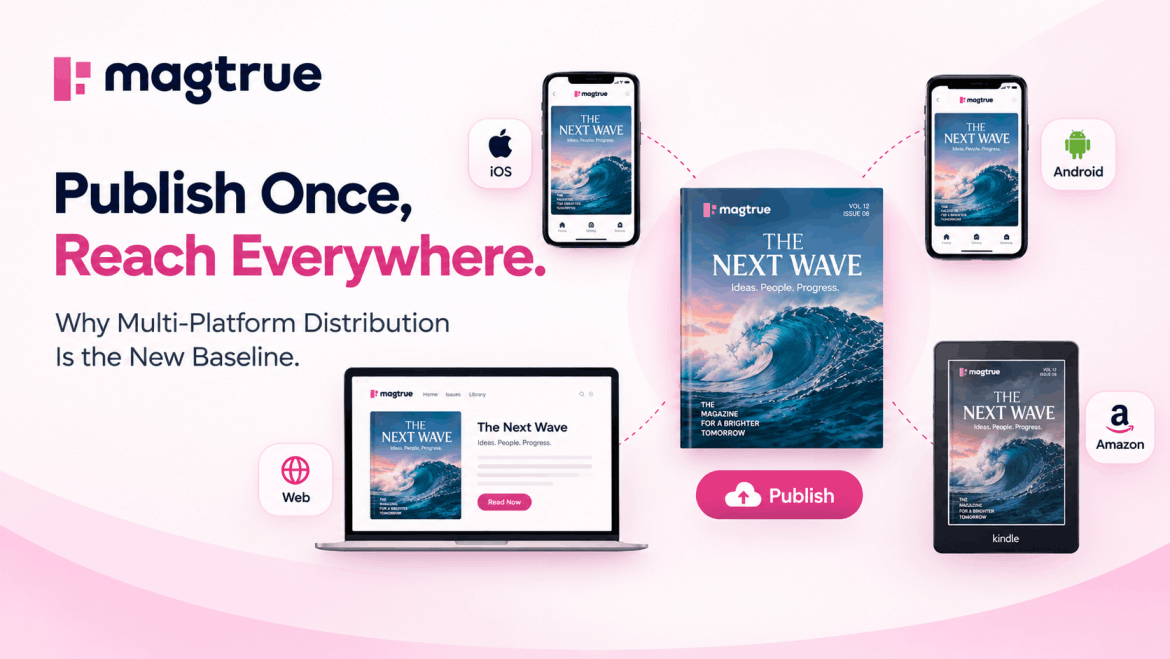
Publish Once, Reach Everywhere: Why Multi-Platform Distribution Is the New Baseline
For publishers today, creating great content is only half the job. The other half is making sure that content reaches readers wherever they choose to consume it.
That sounds simple. It isn’t.
A single publication may need to reach iOS, Android, the web, Amazon, and other digital platforms—each with different requirements, publishing workflows, store configurations, and product identifiers. What looks like a simple “Publish” button to a reader can represent a surprisingly complex process behind the scenes.
The hidden cost of fragmented distribution
As platforms multiply, so do the workflows required to manage them.
Publishers may find themselves maintaining separate configurations, managing different product IDs, preparing platform-specific builds, handling app-store requirements, and keeping content synchronized across multiple channels.
For a small publishing team, this can quickly become a significant operational burden.
Instead of spending time on editorial strategy, audience growth, and creating better content, teams can end up spending hours managing the infrastructure required to deliver that content.
And the cost isn’t only measured in hours.
Fragmented distribution can mean:
- More workflows to maintain
- More opportunities for configuration errors
- More operational overhead
- Slower releases
- Greater difficulty keeping platforms synchronized
- Missed opportunities to reach readers on their preferred device
The result is a publishing process that becomes more complicated as reach expands.
One content strategy. Multiple destinations.
The future of digital publishing isn’t about choosing between platforms.
It’s about making the platforms work together.
Publishers should be able to manage their content and distribution from a central system while delivering experiences across the channels their audiences already use.
That means the complexity of builds, configurations, distribution, and platform-specific requirements should happen behind the scenes—not become another responsibility for the editorial or publishing team.
The goal is simple:
Create once. Manage centrally. Publish everywhere.
Multi-platform is becoming the baseline
Readers don’t think in terms of publishing platforms.
They simply expect content to be available on the device they use.
Someone may read an issue on an iPhone today, continue on an Android tablet tomorrow, and access the same publication through the web later. The expectation is increasingly about accessibility and convenience—not which platform the publisher used to deliver it.
For publishers, that changes the role of distribution.
Multi-platform reach is no longer just a competitive advantage or an advanced feature. It is becoming a fundamental part of the digital publishing experience.
The technology behind distribution should make that possible without adding unnecessary complexity.
From managing platforms to managing publishing
The real opportunity isn’t simply to support more platforms.
It’s to make those platforms feel like one publishing workflow.
When distribution infrastructure is abstracted away, publishers can focus on what actually matters: their content, their audience, their brand, and their business.
That’s the promise of a modern publishing platform like Magtrue—bringing content management, publishing workflows, and multi-platform distribution together so publishers can spend less time managing infrastructure and more time building their publications.
Publish once. Reach everywhere.
The question is no longer whether your content should be available across platforms.
It’s how many platforms is your content reaching today?
 , All Rights Reserved.